Hyper3D · Deemos
Rodin 3D
Hyper3D Rodin Gen-2.5, online
Rodin 3D is the AI 3D model line from Hyper3D, the 3D generation brand of Deemos Tech. Ship3D runs Rodin Gen-2.5 Fast through the fal API as our Pro tier, the default for image to 3D. Upload one picture and the Rodin 3D model comes back in about 40 seconds: a mesh of up to 20,000 triangles with a full PBR texture set (base colour, metallic-roughness and a normal map, each 2048 × 2048). Download it as GLB, STL, OBJ or USDZ; every format other than GLB is converted in your browser. In our side-by-side test on the same image, Rodin 3D kept the colours, the face and small parts such as bells and jewellery much closer to the input than TRELLIS, our Standard tier. The trade-off is the 20K-triangle cap, so very fine detail gets simplified. Ship3D is not affiliated with Hyper3D or Deemos, and every picture on this page comes from our own test.
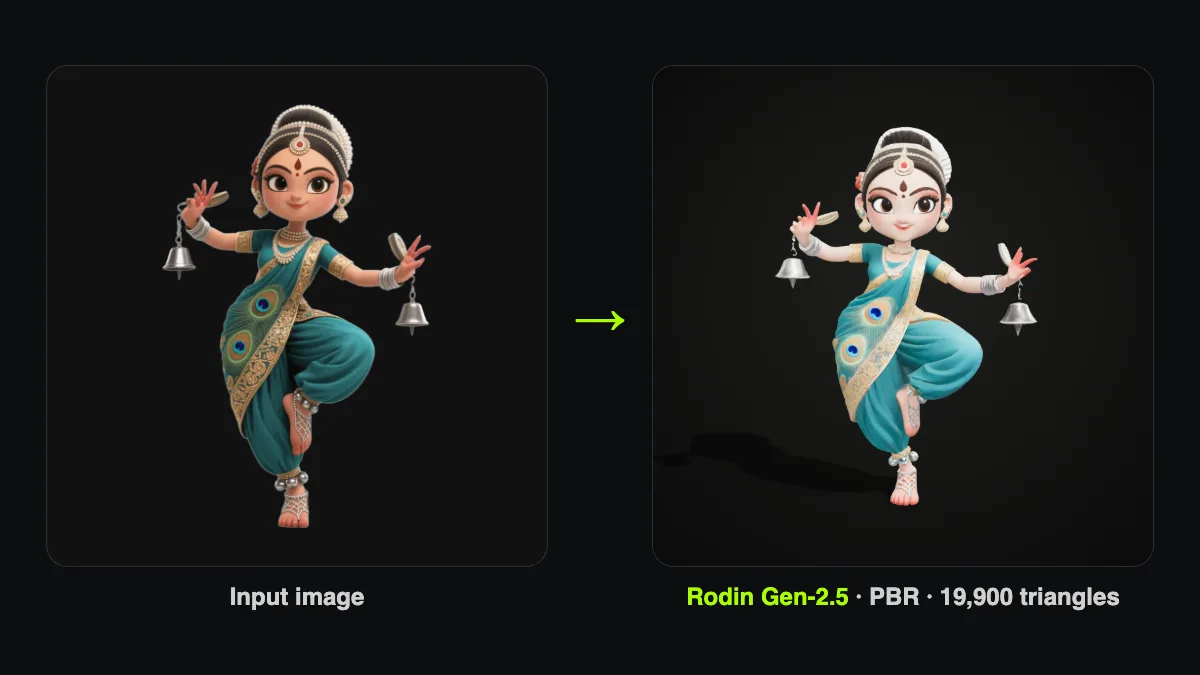
Rodin 3D test results on Ship3D
On 19 November 2026 we sent one image through Rodin Gen-2.5 Fast with the exact settings Ship3D uses (tier Gen-2.5-Low, PBR material, 20K-triangle mesh), and through TRELLIS for comparison. The renders below come from those two files, lit the same way. One test is not a benchmark, and your results will depend on your image.





Rodin 3D on Ship3D: specs
| Model & tier | Input | Download formats | Credits per model |
|---|---|---|---|
| Rodin Gen-2.5 · Pro | One image (PNG, JPG, WebP) | GLB · STL · OBJ · USDZ | 40 |
What Rodin 3D does well
- Colour fidelity: in our test Rodin 3D kept the teal trousers, the skin tone and the peacock pattern, where TRELLIS turned the trousers dark blue.
- A full PBR material set at 2048 × 2048 (base colour, metallic-roughness, normal), embedded in the GLB, so the model lights correctly in game engines, AR and web viewers.
- Small parts become real geometry: the bells, fingers and jewellery are modelled shapes, not just paint on a blob.
- A closed mesh: our test file had no open edges and no non-manifold edges, which is what a slicer wants from an STL.
- Quick: 37 seconds end to end in our test, including 5 seconds in the queue.
- Light files: about 20,000 triangles and a 2.9 MB GLB load fast on the web and in AR.
What to keep in mind
- The Fast version caps the mesh at 20,000 triangles. Very fine detail such as lace, thin chains, engraved text or the fingers of a small hand gets simplified or flattened. fal itself describes the Fast endpoint as mainly for prototyping and testing.
- Ship3D sends one image. Rodin accepts up to five, but multi-view input is not offered on Ship3D, so the back and hidden sides are guessed from one view.
- No auto-rigging, no part splitting and no FBX or 3MF download. Ship3D asks Rodin for a GLB and converts it to STL, OBJ or USDZ in your browser.
- Rodin is a closed model: you cannot download its weights or host it yourself. Ship3D calls it through fal’s API.
- Public leaderboards rank Rodin Gen-2.5 on its slower High tier, not on Fast. Our view of Fast rests on our own test, not on a benchmark.
Tips for better Rodin 3D results
- 1Use one subject on a plain or transparent background, fully in frame.
- 2A three-quarter view shows depth; a flat front-on picture leaves the sides to guesswork.
- 3Rodin 3D copies the colours of your picture closely, so fix colour casts and dark shadows in the image first.
- 4For tiny detail (lace, chains, lettering), crop closer or simplify the picture, because a 20K-triangle mesh cannot hold everything.
- 5For 3D printing, download the STL, scale it in your slicer and check thin parts such as fingers and bell loops.
- 6If a result misses, try a cleaner crop or another angle before you generate again; each run uses credits.
Rodin 3D FAQ
What is Rodin 3D?
Rodin is a family of AI models from Hyper3D, the 3D brand of Deemos Tech, that turn images or text into textured 3D meshes. Gen-2.5 is the current generation. Hyper3D sells Rodin through its own app and API, and fal hosts it as an API, which is how Ship3D runs it.
Which Hyper3D Rodin version does Ship3D use?
Rodin Gen-2.5 Fast (fal-ai/hyper3d/rodin/v2.5/fast) with the Gen-2.5-Low tier, PBR material and the 20K-triangle mesh option. It is the Pro tier on Ship3D and the default for image to 3D. Hyper3D’s slower, denser tiers are not offered here.
How many credits does a Rodin 3D model cost?
40 credits per model, and the Generate button shows the cost before you start. Downloading GLB, STL, OBJ or USDZ costs nothing extra, and a failed run is refunded automatically.
Is Rodin 3D good for 3D printing?
For figurines and small decor, yes. Our test mesh was closed, with no open or non-manifold edges. At 20,000 triangles, curved surfaces can show flat facets on a large print, and thin parts such as fingers still need a check in your slicer.
Can I use Rodin 3D models commercially?
Ship3D’s terms allow commercial use of models generated on a paid plan, for example in games, product mockups and printed goods. fal lists Rodin as licensed for commercial use and its terms claim no rights in the output. Only upload images you have the right to use.
Rodin 3D or TRELLIS: which should I pick?
Pick Rodin (Pro) when colours, faces and small parts matter: in our test it matched the input far better and came with full PBR maps. TRELLIS (Standard) is Microsoft’s open model with a single 1024 colour texture, fine for a quick rough shape.
Can Rodin 3D do text to 3D on Ship3D?
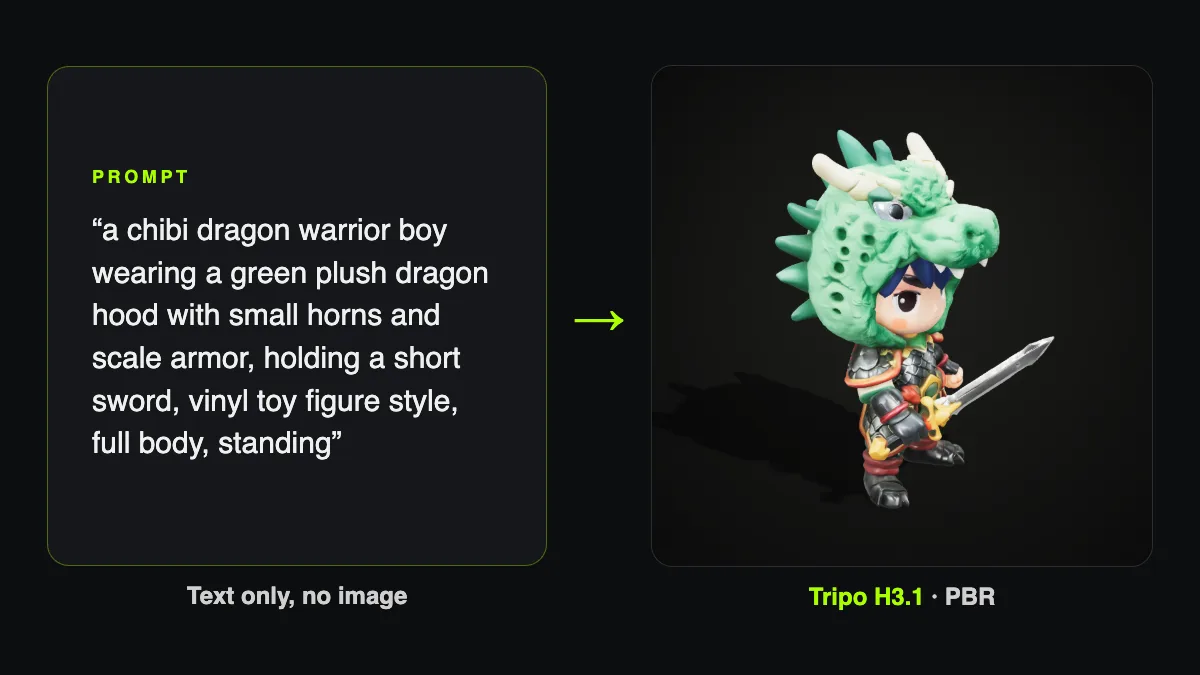
Hyper3D also offers a text-to-3D Rodin model, but Ship3D does not use it. For written prompts, Ship3D runs Tripo H3.1 on the text-to-3D page.
Try Rodin 3D now
Upload one image and get a PBR-textured Rodin 3D model in about 40 seconds. Free to sign up; the credit cost is shown before you start.
Try Rodin 3D